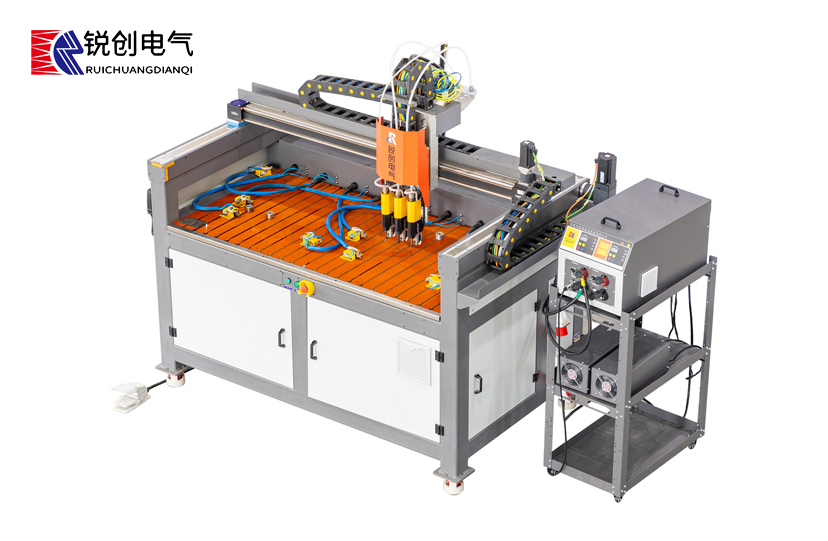
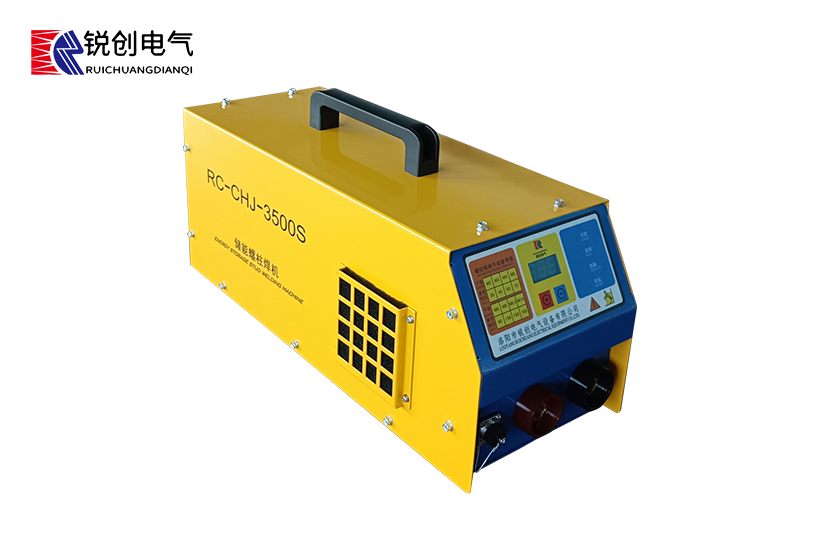
Drawn Arc Stud Welders
Weldable stud size: M3-M24
Sheet thickness: 1.5mm+
Key Features: Key Features: Strong Weld Strength, Deep Penetration, Stable Arc Control
Advantages:
✅ High-strength welded joints
✅ Suitable for various material thicknesses
✅ Reliable performance for industrial production
✅ Minimal post-processing after welding
Applicable Materials: Carbon Steel, Stainless Steel, Mild Steel, Alloy Steel
Drawn Arc Stud Welders — Short & Long Cycle Arc Stud Welding Machine for Structural and Heavy-Duty Applications
Drawn Arc Stud Welders from Luoyang Ruichuang Electrical Equipment Co., Ltd. are designed for industrial fastening tasks where weld strength must meet or exceed the demands of the parent material. Ruichuang, established in 2002, is a manufacturer of arc stud welding equipment capable of welding studs from M3 to M24 on base materials from 1.5 mm thickness, operating on DC power from 300 to 3000 Amps, supporting both short cycle and long cycle modes across carbon steel, stainless steel, mild steel and alloy steel.
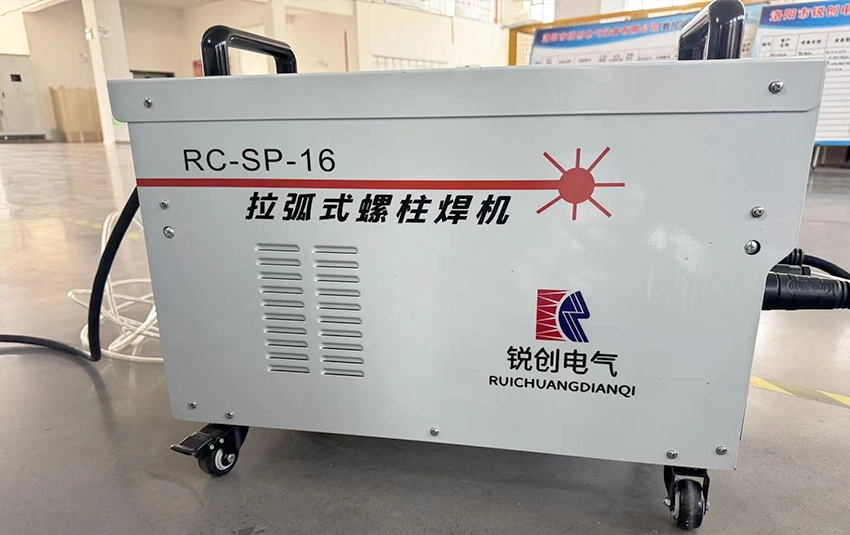
What Is a Drawn Arc Stud Welders?
An arc stud welder is industrial equipment for the direct attachment of a metal fastener to a base metal by use of a regulated electric arc. The arc melts the tip of the stud and the surface of the work piece. The stud is then plunged into the molten pool to establish a complete cross section fusion bond.
This procedure eliminates drilling, tapping and riveting. This results in less work time and better joint integrity. It further eliminates the possibility of leaking in pressure vessels and fluid storage tanks common in through-hole fastening.
The result is a metallurgical bond, not a mechanical connection, hence the joint has load-bearing qualities derived from fusion rather than clamping force.
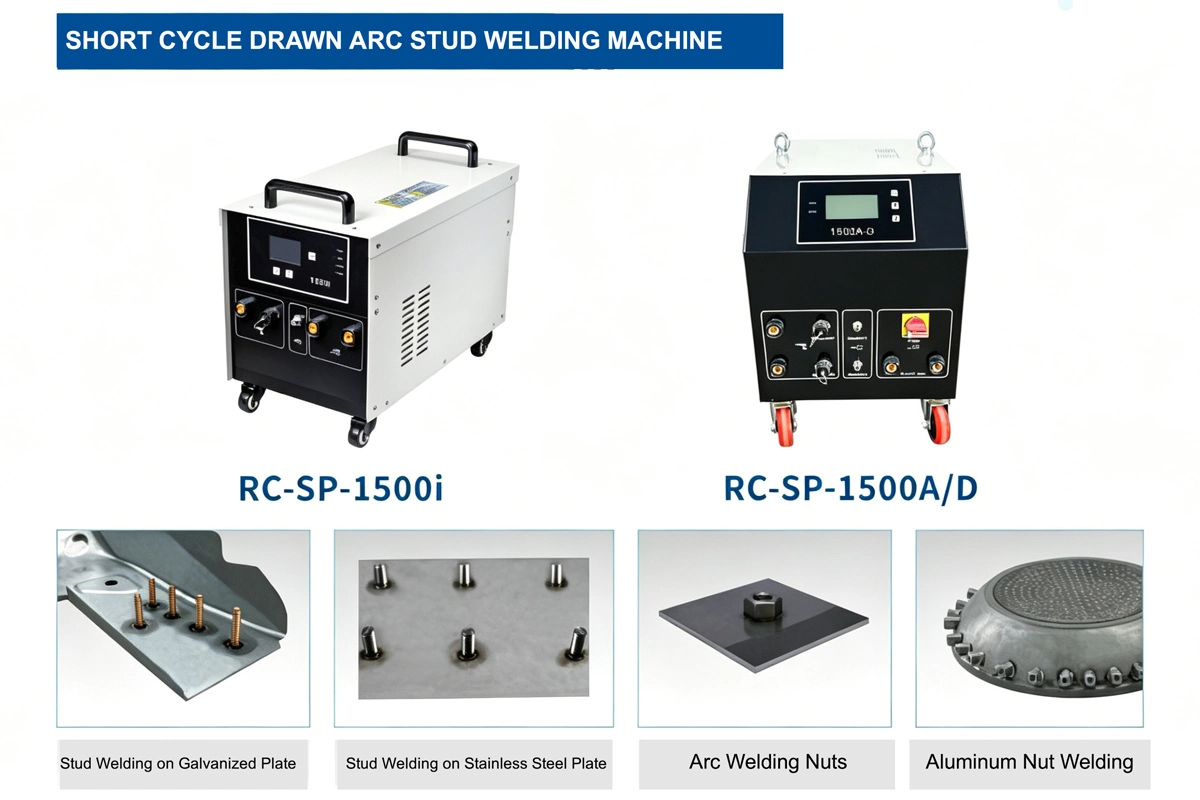
Key Technical Specifications
| Product Name | Short-Cycle Stud Welder | Long-Cycle Stud Welding Machine | ||
| Product model | RC-SP-16 | RC-SP-25 | RC-LP-16 | RC-LP-25 |
| Welding Process | Short arc time with rapid stud welding process | Longer arc time for deep penetration welding | ||
| Stud Diameter Range | M3 – M12 (depending on material and application) | M6 – M25 (depending on model and application) | ||
| Welding Time | approx 1~1500ms | approx 20~1500ms | ||
| Base Material Thickness | 0.5-3mm,Thin to medium sheet metal | ≥2mm, Medium to thick plates | ||
| Welding Materials | Steel, stainless steel, galvanized steel, aluminum (depending on model) | |||
| Welding current | 100~1600A | 100~2200A | 200~1500A | 400~2400A |
| Welding Speed | 15-30 studs/minute (welding M3 or 2mm) | 4-20 studs/minute | 6-30 studs/minute | |
| Power Supply | AC 380V±10%/50Hz (three-phase five-wire) | |||
| Open circuit voltage | 30~60V | |||
| External dimensions | 665*345*550mm | 700*460*610mm | ||
Core Performance Advantages
Deep Weld Penetration for Structural Applications
The drawn arc method provides a deep melt pool and is appropriate for joints that have to carry heavy loads and vibration. The heat affected zone creates a robust, leak resistant bond under regulated processing conditions.
Short Cycle and Long Cycle Mode
Short cycle mode minimises heat input for thinner plates where distortion is an issue. The long cycle mode allows for thorough penetration of thick steel plates and big diameter studs up to M24. Depending on the workpiece requirements operators may switch modes.
High Volume Production Arc Behaviour Consistency
The equipment produces a consistent arc over long production runs, resulting in weld quality consistency from one joint to the next.
Requires no drilling
No pre-drilling is performed in an effort to save labour and to prevent weakening the structure by through-holes. Very little post-processing is required on the completed joint.
Tolerant of Light Surface Rust & Mill Scale
Drawn arc stud welding can penetrate surface contaminants such as mill scale, unlike capacitor discharge welding, which is suitable for normal manufacturing floor circumstances.
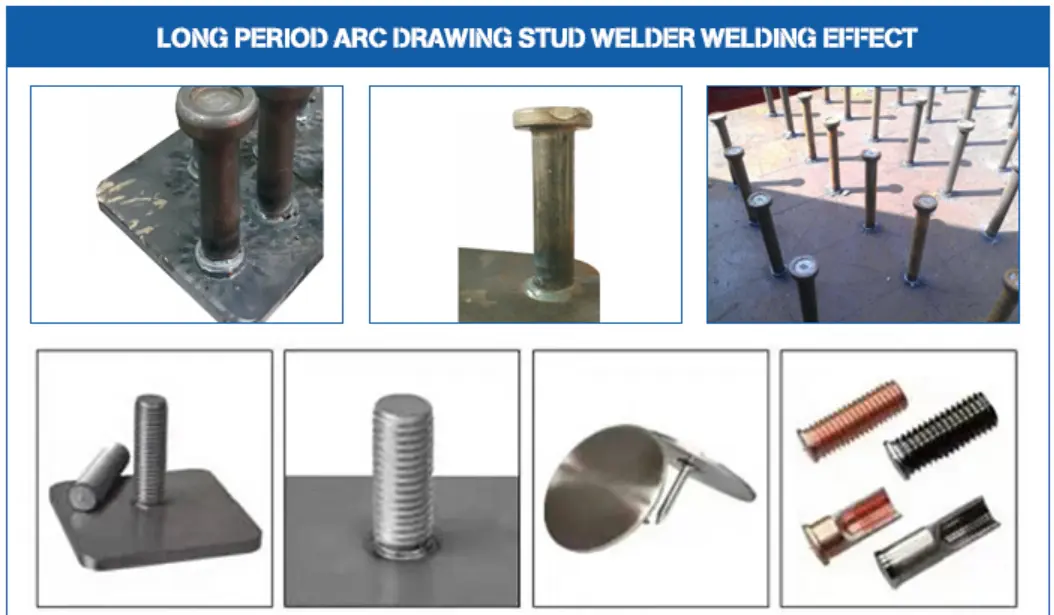
Applications Across Industries
Steel Construction and Bridge Assembly
Shear connectors are welded to steel beams to link steel structures with concrete slabs. The weld transfers shear forces reliably over the structure's service life.
Shipbuilding and Offshore Platforms
In maritime situations when corrosion resistance and joint stability are essential, insulation pins and cable management anchors are mounted on strong hull plates.
Power Generation & Industrial Boilers
Refractory anchors are welded onto the interior of combustion chambers and heat exchangers when thermal cycling and high pressure render mechanical fastening less dependable than welded connections.
Heavy Machinery and Steel Cabinets
Large-diameter studs on machine frames, enclosures, and equipment panels benefit from drawn arc welding of Drawn Arc Stud Welders because of load-bearing requirements and the thickness of the base material involved.
Quality Control Standards
All welds are subjected to the known inspection techniques.
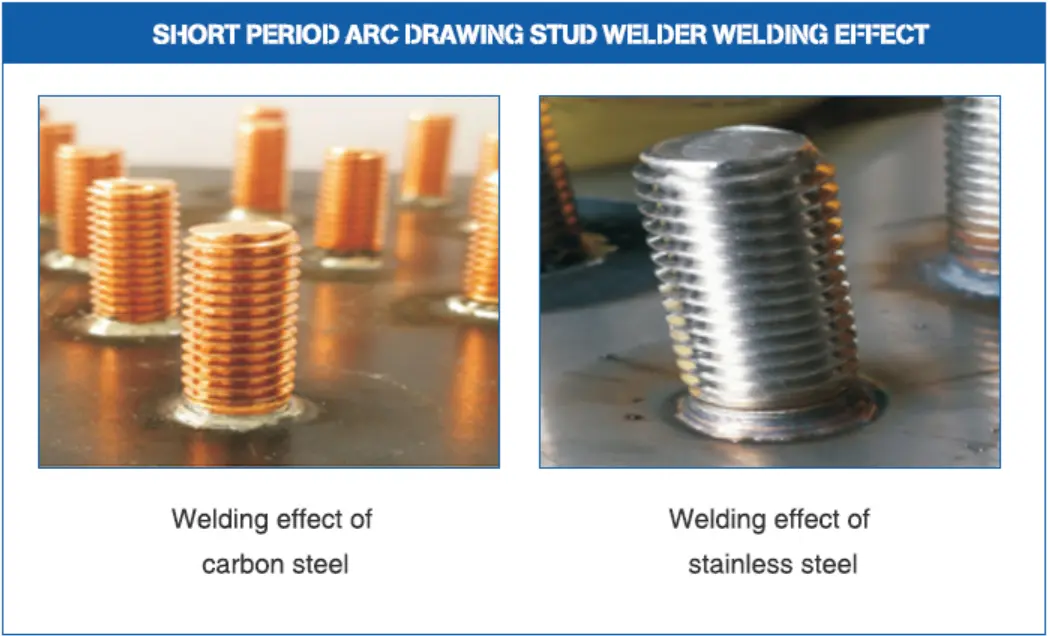
Visual Inspection – Check for a consistent 360 degree weld collar (flash) created by the ceramic ferrule. An even collar shows that the arc is correctly distributed.
Bend Testing — Bend stud 30 to 60 degrees. If there are no fractures in the heat-affected zone, then the weld is standard. It is suggested this test be performed at the start of each production shift to check calibration.
Tensile and Torque Testing—Determine the load at which the stud or weld breaks. The results must fulfil the design load requirements for your project.
Macro-Etch Inspection - Cross-section inspection is used to ensure conformance to ASTM and ISO structural requirements by checking for internal porosity or lack of fusion.
Why Choose Ruichuang Stud Welding Equipment?
Ruichuang combines mechanical design, electrical engineering and software development in one firm. After installation and commissioning, the after-sales staff will offer technical assistance, maintenance advice and troubleshooting. Additionally, the company's Automation instruction Center offers hands-on instruction in PLC programming and equipment operation.
With over 20 years of expertise in sheet metal automation and industrial welding equipment, Ruichuang can help clients from equipment selection to long-term stable production.
FAQ
Q:What is the advantage of drawn arc stud welding compared with CD stud welding?
A:Drawn arc delivers a stronger weld joint suited to large studs and thick plate connections where structural load requirements are high. CD welding is designed for thin sheet metal where surface finish and low heat input are the priority.
Q:What stud sizes can the products handle?
A:The machine supports studs from M3 up to M24, covering a wide range of structural and heavy-load fastening requirements.
Q:Can it weld on thick steel plates and steel structures?
A:Yes. The high arc energy and stable fusion process make the products widely used for steel structures, bridges, and heavy machinery where penetration depth is critical.
Q:Can drawn arc welding work on aluminum studs and aluminum plates?
A:Yes. Aluminum welding requires Argon shielding gas instead of a ceramic ferrule to prevent porosity. Dedicated parameter settings are available for aluminum base materials and studs.
Q:What is the difference between short cycle and long cycle drawn arc mode?
A:Short cycle mode is suited for thinner plates where controlled heat input prevents distortion. Long cycle mode is used for thick plates and large studs to achieve full weld penetration.
Q:What causes inconsistent weld quality?
A:Common causes include incorrect lift settings, insufficient welding current, or the welding gun not being held perpendicular to the workpiece. Running a bend test at the start of each shift helps identify calibration issues before full production begins.
Contact Us
Have a question about our Drawn Arc Stud Welders or a specific application requirement? Reach our team directly at sales@lyrcautomation.com.